© 2026 AnChain.AI. All Rights Reserved | Privacy Policy



A few days ago, Bank of America’s $1.2 billion FinCEN penalty highlights costly failures in AML monitoring and reporting.
Although unrelated to crypto, the case offers critical lessons for digital asset firms scaling their compliance programs.
Source: U.S. Treasury enforcement announcement
On October 13, 2026, FinCEN announced a massive $1.2 billion penalty against Bank of America. The bank admitted willful Bank Secrecy Act violations involving its AML program, foreign correspondent banking due diligence, and suspicious activity reporting.
According to Department of Treasury:
Sources: FinCEN penalty announcement · Treasury’s findings
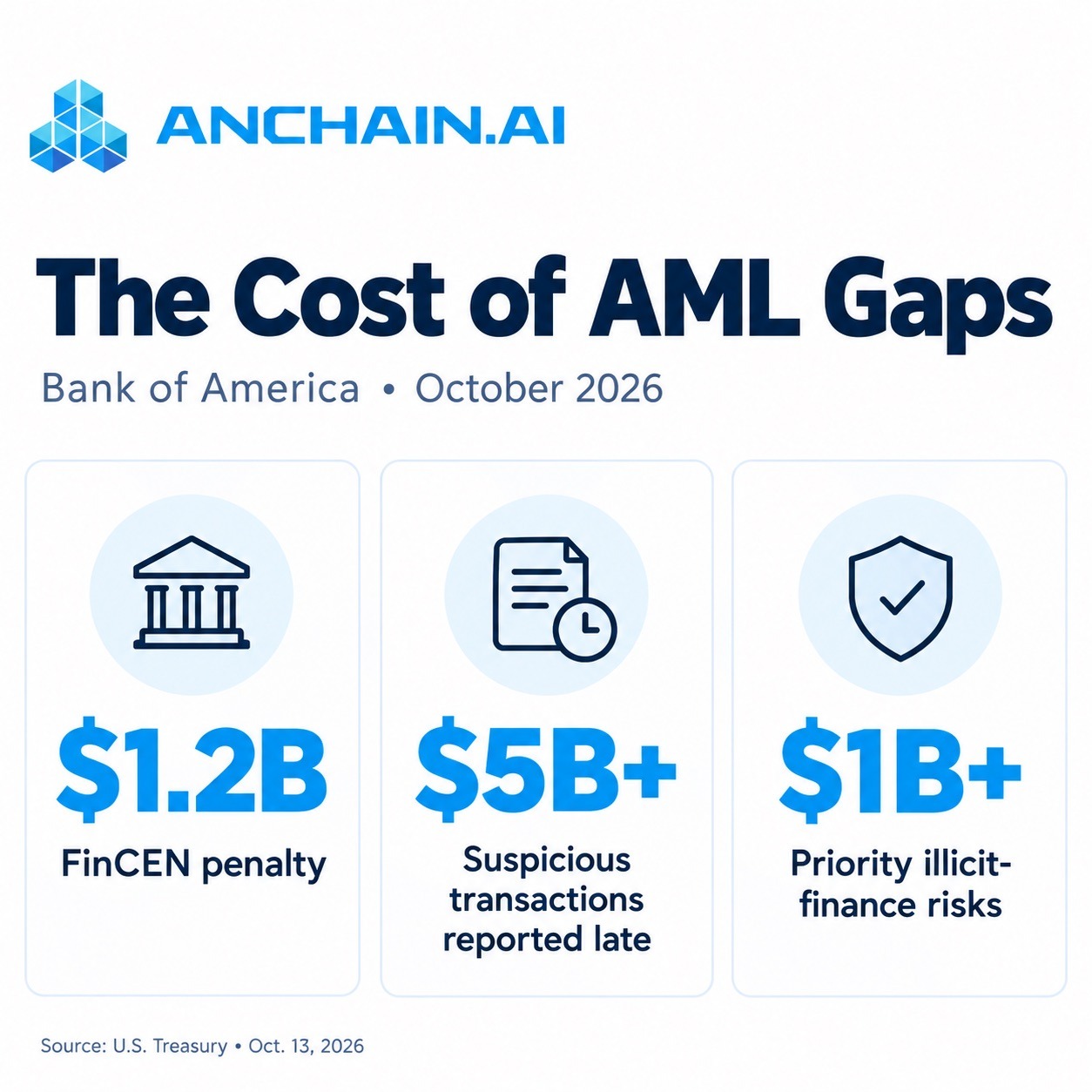
For financial services leaders, the practical question is whether compliance controls produce timely, defensible decisions. A monitoring system has limited value when important alerts remain uninvestigated or known gaps remain unresolved.
That question is especially relevant to small and midsize crypto exchanges, custodians, RWA platforms, and payment providers expanding their products with lean compliance teams.
The connection is operational: customer understanding, effective monitoring, timely investigation, and documented decisions matter across financial products. The Bank of America case provides lessons for crypto businesses without being a crypto-related enforcement action.
FATF’s July 2026 virtual-asset review found that 83% of surveyed jurisdictions had enacted Travel Rule legislation, up from 73% in 2025.
However, FATF identified continuing gaps in supervision, enforcement, and oversight of offshore providers and DeFi arrangements. Passing legislation does not automatically produce effective controls.
Source: FATF’s July 2026 virtual-asset review
FATF’s March 2026 stablecoin report estimated that stablecoins represented 84% of illicit virtual-asset transaction volume in 2025. This measures stablecoins’ share of identified illicit volume—not the percentage of stablecoin activity that is illicit.
Source: FATF report on stablecoins and unhosted wallets
In the United States, FinCEN’s April 2026 AML reform proposal emphasized effective, risk-based programs that direct resources toward higher-risk activity. This proposal is a separate policy development from the Bank of America enforcement action.
Source: FinCEN’s AML program reform proposal
The following are applications to digital assets, not findings about Bank of America’s crypto activities.
A wallet risk score is one input. Investigators should also consider expected customer activity, source of funds, counterparties, transaction frequency, and economic purpose.
For RWA platforms, connect token transfers and redemption activity with investor and ownership records. For payment providers, compare settlement flows with the customer’s stated business and expected transaction patterns.
Where risk warrants it, examine upstream funding, downstream destinations, swaps, and bridge activity.
Record the evidence supporting each attribution. Distinguish verified ownership from inferred relationships, and avoid treating proximity to a flagged address as proof of wrongdoing.
Assign high-risk alerts an owner, escalation criteria, and a review deadline.
Track unresolved cases and investigation age so transaction growth does not quietly create an unmanaged backlog. Give management visibility into cases awaiting evidence, analyst review, or escalation.
Reviewing generated alerts alone cannot show what a system fails to detect.
Sample unflagged activity, evaluate thresholds, and document how monitoring changes affect coverage. Revisit assumptions when introducing new tokens, networks, customer segments, or payment corridors.
Retain transaction hashes, timestamps, relevant labels, tracing results, and the rationale for each case disposition.
Suspicious activity reporting decisions should follow applicable requirements and receive appropriate review. Another analyst should be able to understand what was examined, what remains uncertain, and why the team acted.
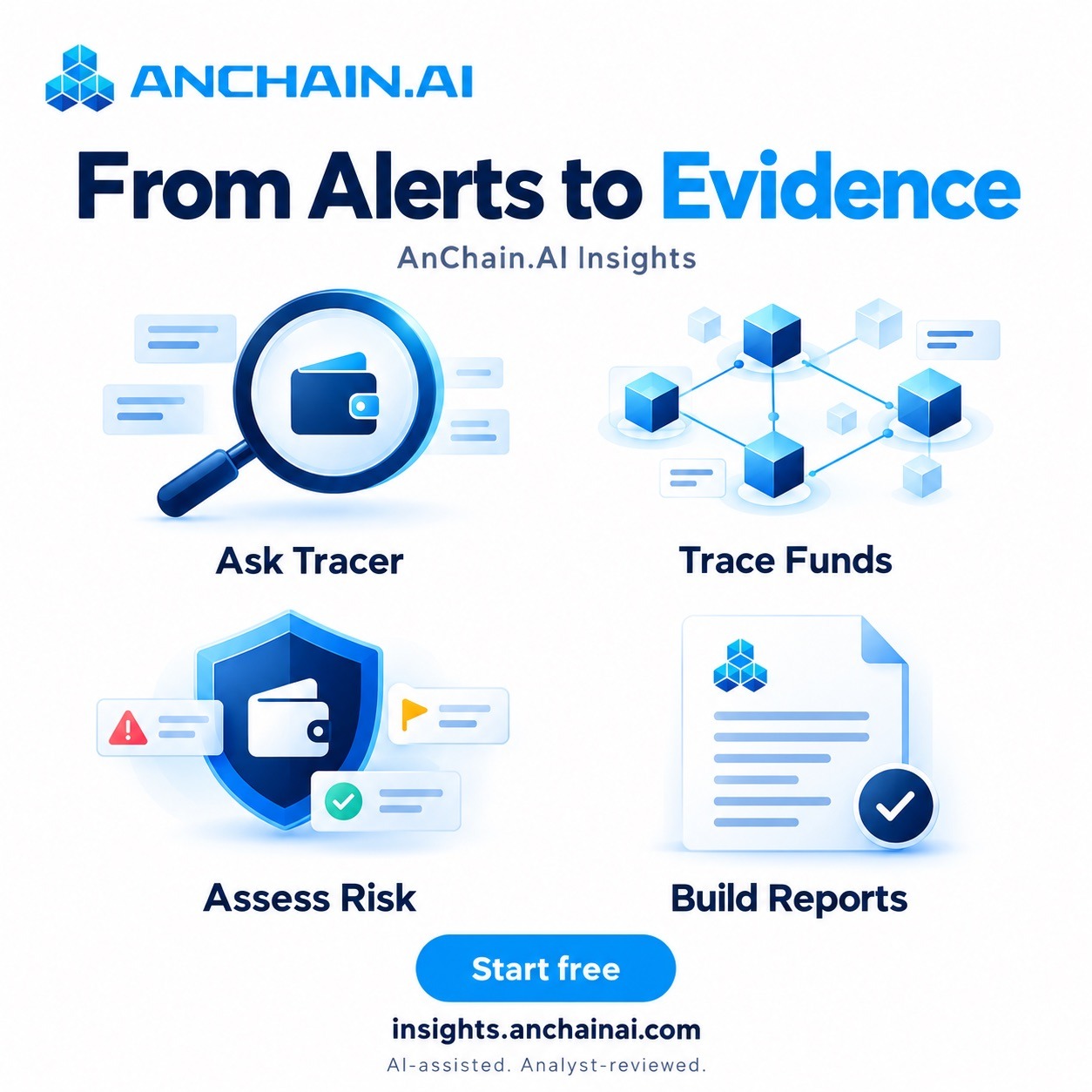
AnChain.AI Insights brings AI agents into blockchain investigations, helping smaller teams examine complex activity and organize evidence.
These capabilities support investigative work within an AML program. Firms still need customer due diligence, appropriate policies, trained staff, and accountable decisions.
Bank of America’s case concerns traditional banking. Digital asset businesses can use it to examine their own controls before transaction growth outpaces their ability to investigate.
Start your first investigation free with AnChain.AI Insights
Disclaimer: This article is for informational purposes only and does not constitute legal or compliance advice. The Bank of America enforcement action discussed banking AML failures, not crypto-related misconduct. Digital asset examples reflect AnChain.AI’s analysis, not regulatory findings in this case. Requirements vary by jurisdiction and business activity; consult qualified counsel. AnChain.AI tools support investigations but do not guarantee compliance.
© 2026 AnChain.AI. All Rights Reserved | Privacy Policy