© 2026 AnChain.AI. All Rights Reserved | Privacy Policy


Note: This article was derived from our CEO Victor Fang's presentation at UC Berkeley, in Aug 2025.
The global fight against the $2 Trillion money laundering problem is entering a new phase. As cryptocurrency adoption accelerates, stablecoin market capitalization reaches record highs, and regulators sharpen their focus, traditional Anti-Money Laundering (AML) workflows are straining under the weight of scale, cost, and complexity.
At the Decentralized AI Summit at UC Berkeley, AnChain.AI outlined a new approach: Agentic AML (Anti Money Laundering) —a system of specialized AI agents designed to fundamentally reshape how financial institutions investigate, analyze, and report financial crime in the GENIUS Act era.
Money laundering is not a marginal issue—it is a systemic one. Per Financial Action Task Force (FATF), over $2 trillion is laundered globally each year, while financial institutions spend approximately $61 billion annually on AML compliance. Despite this massive investment, enforcement fines reached $24 billion in 2024 alone.
Operationally, the burden is severe:
At the same time, crypto-native risks are exploding. Stablecoins alone have reached a $240 billion market cap, amplifying both legitimate use cases and illicit activity across payments, DeFi, and cross-border flows.
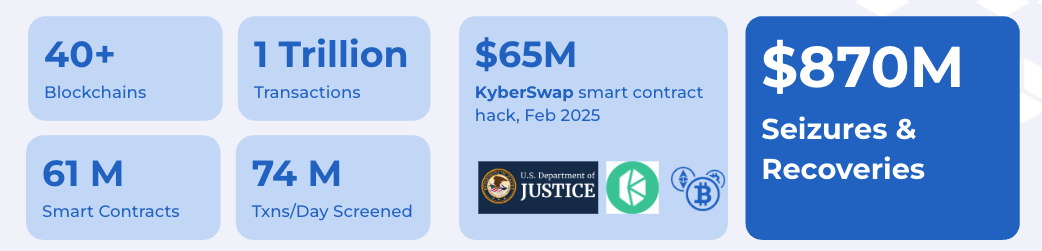
AnChain.AI’s journey began in cryptocurrency investigation—long before “agentic AI” became a buzzword. Its platform has supported investigations across 40 blockchains, screened 74 million transactions per day, analyzed 61 million smart contracts, and underpinned more than $870 million in seizures and recoveries worldwide, including high-profile cases involving the IRS, DOJ, and FinCEN. One notable example is the $65 million KyberSwap DeFi hack, announced by the U.S. Department of Justice in February 2025. AnChain.AI’s smart-contract and transaction-tracing capabilities played a key role in tracking illicit flows, including $14 million in stablecoins. These crypto investigations exposed a broader truth: the same AI techniques used to trace blockchain crime could transform traditional AML workflows.
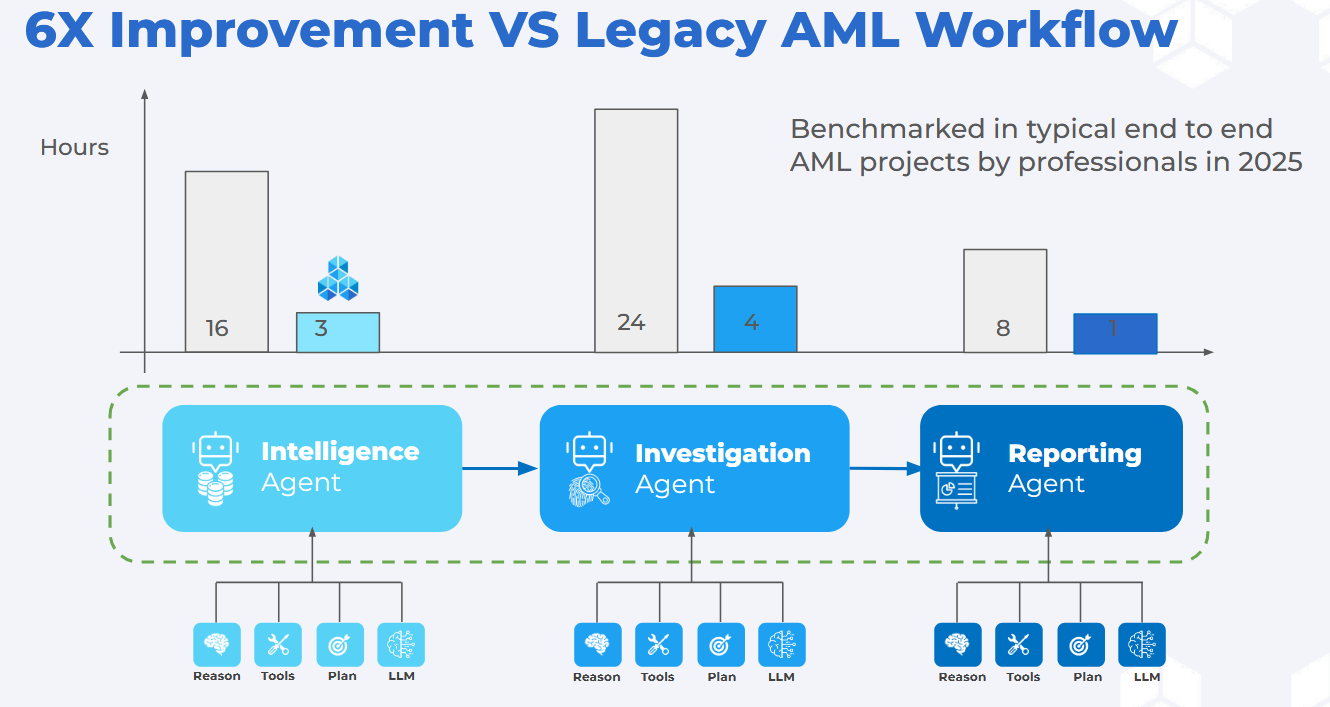
Traditional AML processes are linear, manual, and slow. Intelligence gathering, investigation, and regulatory reporting areften treated as separate stages—each with its own tools, queues, and delays. Benchmarking data from 2025 AML projects shows that legacy workflows commonly require:
That’s nearly two full days per case, multiplied across tens or hundreds of thousands of alerts per year.
Agentic AML replaces monolithic workflows with a coordinated system of AI agents, each designed for a specific compliance task—while keeping humans firmly in the loop.
The Three Core Agents
Together, these agents reduce end-to-end AML case time by approximately 6× compared to legacy workflows.
One of the most important messages from the presentation is also the most grounded: AI hallucination is real—and dangerous in compliance contexts.
In AML, hallucinations aren’t amusing—they can lead to false positives, missed risks, or regulatory exposure. Agentic AML explicitly embeds human review at every critical stage, ensuring:
Agentic AML is not just a model—it’s a vertical SaaS stack purpose-built for financial crime:
This architecture allows institutions to balance performance, cost, and regulatory requirements.
The Cost Reality of AI Agents
AI agents are powerful—but not free. Production deployments require careful design to avoid replacing human inefficiency with machine inefficiency.
The takeaway is clear: agentic AI must be purpose-built, cost-aware, and selectively deployed—not treated as a generic automation layer.

As stablecoins and crypto payments move closer to the regulatory core of the financial system, the GENIUS Act is expected to dramatically increase compliance expectations for fintechs, payment companies, and financial institutions (CNBC)
The scale regulators are reacting to
What the GENIUS Act changes
This creates a perfect storm:
Agentic AML is built for the GENIUS Act era—connecting data, AI, and human judgment into a single compliance fabric. It enables institutions to:
As stablecoins become core financial infrastructure, compliance must scale faster than volume. Agentic AML delivers that leverage—turning regulatory pressure into operational advantage.
Agentic AML is not about replacing compliance teams. It’s about giving them leverage—turning days into hours, noise into intelligence, and static workflows into adaptive systems. As financial crime grows more sophisticated, the tools used to fight it must evolve just as quickly. Agentic AML represents a meaningful step toward that future.
👉 Schedule a call with our experts today!
© 2026 AnChain.AI. All Rights Reserved | Privacy Policy