© 2026 AnChain.AI. All Rights Reserved | Privacy Policy


Cryptocurrency recovery can appear daunting given the immutability of blockchain transactions. How can victims recover stolen assets when transactions cannot be reversed?
A recent U.S. Department of Justice (DOJ) case provides a clear case study in successful cryptocurrency recovery.
On March 13, 2026, the DOJ announced the return of approximately $470,735 to two Maine victims of a cryptocurrency investment scheme involving over $800,000 in total losses. The DOJ credited the FBI’s investigation and assistance from Tether.[1]
For law firms advising crypto fraud victims, this successful cryptocurrency recovery illustrates how blockchain tracing, issuer cooperation, and legal process intersect to create an actionable recovery pathway. Read our case study with the leading law firm.
Counsel must establish asset movement, smart contract mechanics, controlling entities, and actionable evidence. AnChain.AI Insights and SCREEN address these requirements through targeted fund tracing and smart contract analysis.[3][5]
This guide examines the public DOJ case to outline a forensic framework for litigation, fraud, and insolvency practice groups evaluating crypto investigation services.
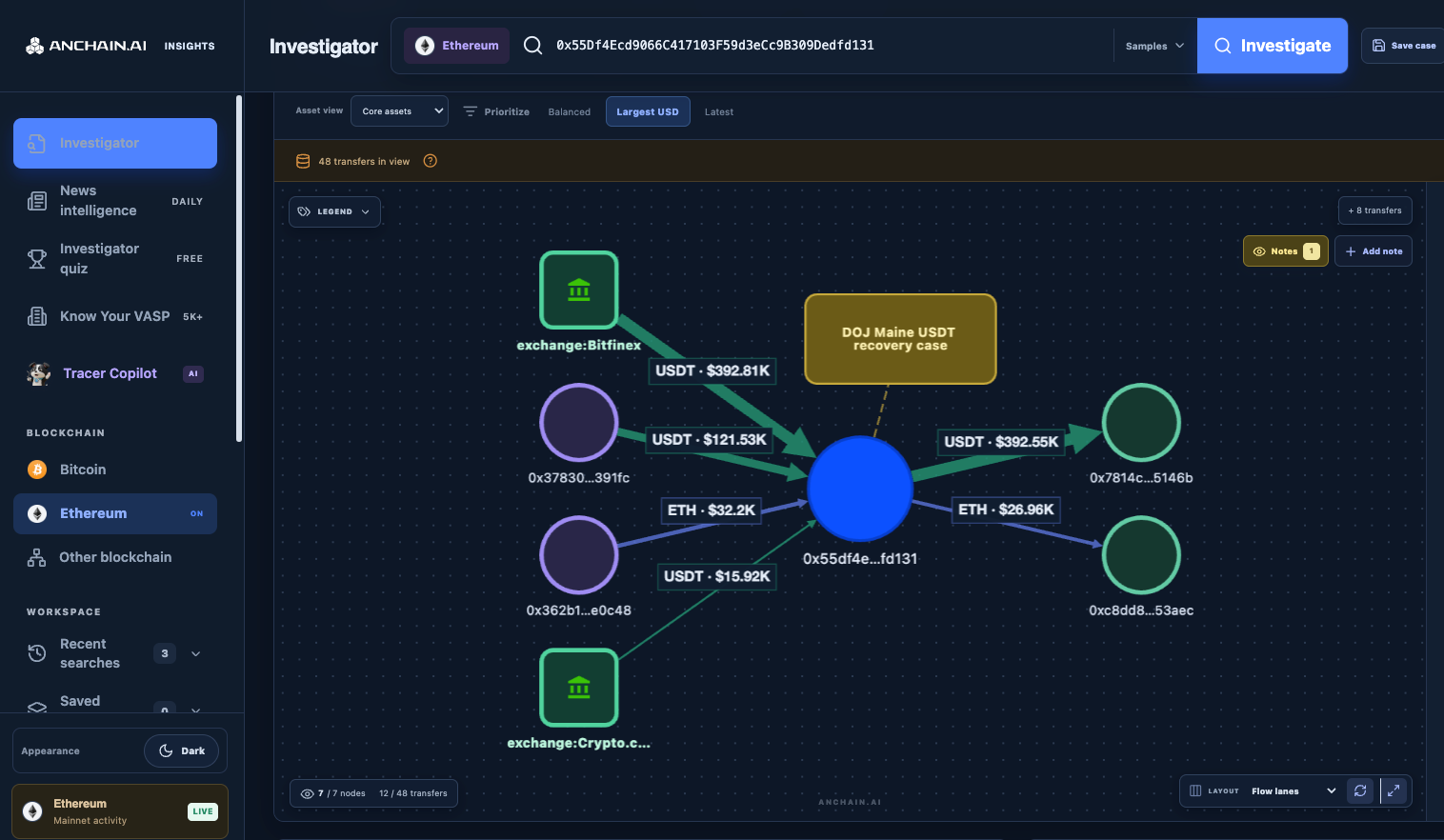
The complaint in United States v. 470,773 USDT (stablecoin by Tether), No. 2:25-cv-00017-LEW, identifies this Ethereum address:[2]
0x55Df4Ecd9066C417103F59d3eCc9B309Dedfd131
Blockchain tracing confirms these transfers on the AnChain.AI Insights platform (Free signup):
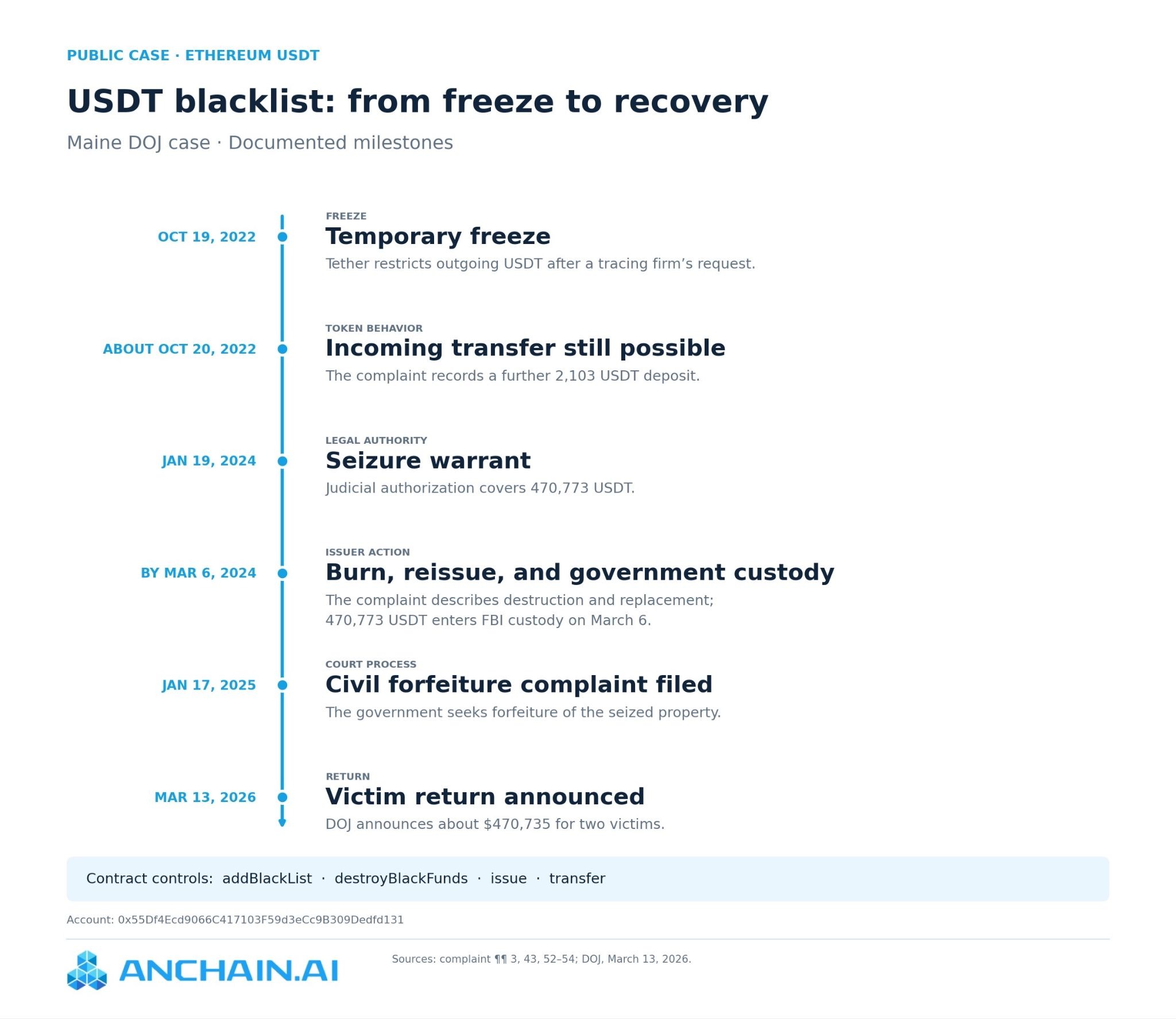
According to the complaint, Tether temporarily froze the target assets in October 2022 following law enforcement contact. A January 2024 warrant authorized seizure, leading Tether to burn the tokens and reissue 470,773 USDT into government custody on March 6, 2024.[2]
The DOJ filed a civil forfeiture complaint in January 2025 and announced the court-ordered forfeiture and victim recovery in March 2026.[1][2]
Define clear legal objectives before scoping a full wallet graph. Urgent asset preservation requires different technical evidence than damages modeling or rebuttal reports.
Ensure investigators align their analysis with the required legal action—whether subpoenaing exchange records, tracing additional wallet hops, evaluating issuer freeze capabilities, or challenging third-party attribution.
Define scope parameters upfront, including target blockchains, specific assets, transaction hashes, timeframes, and budget limits. Scope expansions into tangential wallet networks should require explicit approval.
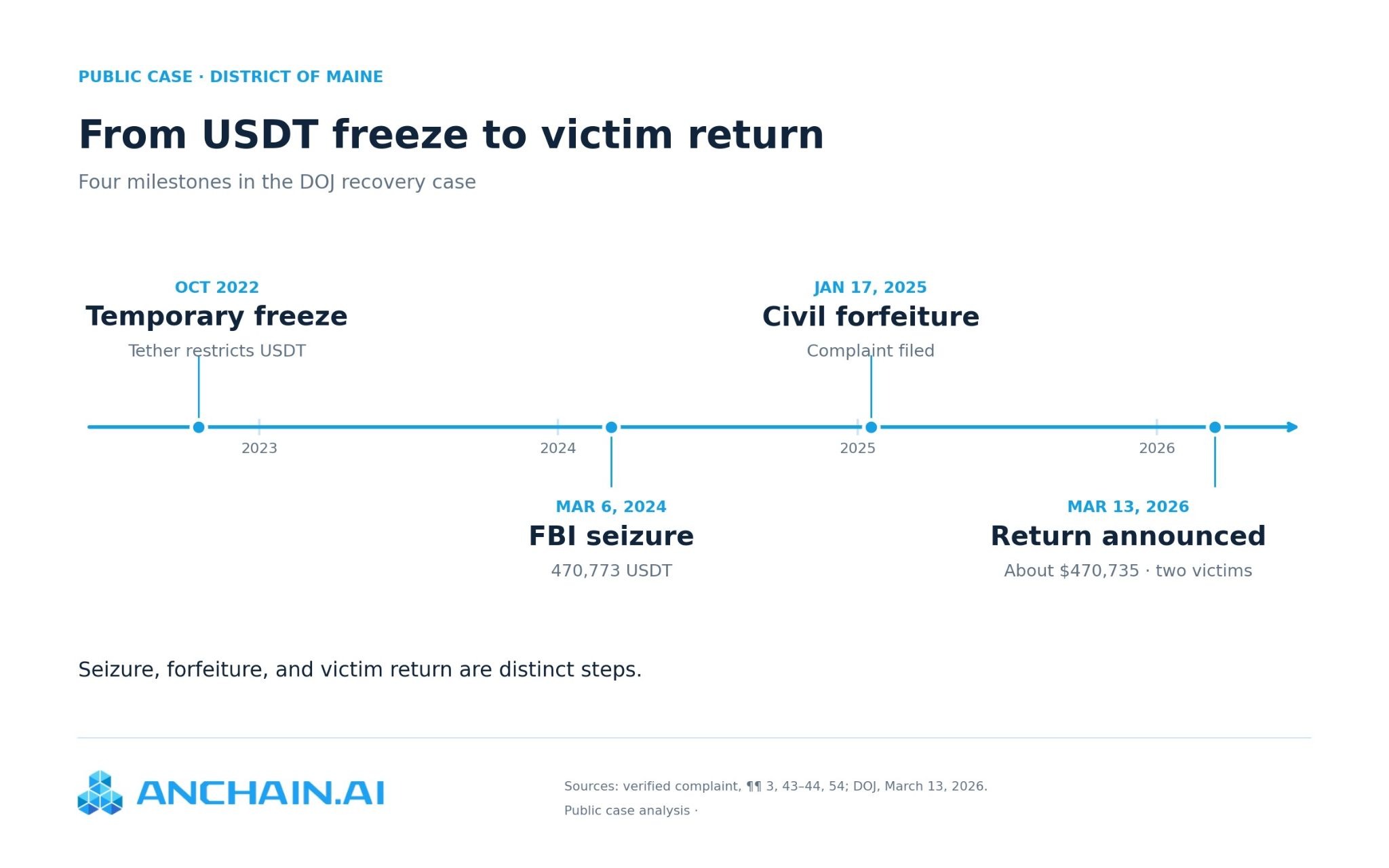
Timeline of the crypto recovery: from freeze to refund.
Every material flow in a transaction graph must be backed by raw parameters: network, transaction hash, block number, timestamp, token contract address, event log index, sender/recipient addresses, and exact transfer amounts.
The ERC-20 standard uses a Transfer event to log transactions alongside balance query methods, forming the foundation for asset reconstruction.[1]
Evidence schedules must record raw integer values alongside decimal conversions. For example, a 6-decimal token records 125,000,000 units to represent 125 tokens; failing to parse decimals accurately distorts transaction totals.
Distinguish the transaction initiator (msg.sender) from token transfer senders logged in contract events. Complex contract calls require internal transaction analysis, and reverted transactions must be excluded from completed-transfer totals.
Visualizing transfers between addresses is insufficient in smart contract disputes. Counsel must also understand the underlying execution logic, access controls, and administrative privileges.
AnChain.AI SCREEN evaluates smart contract risk through source code and bytecode analysis, transaction simulation, and contract state verification to assess administrative functions, internal calls, and net balance updates.[5][6]
In stablecoin matters, analysis focuses on blacklist, mint, and burn capabilities. In DeFi disputes, analysis centers on function calls, routing logic, fee structures, and state changes. When source code is unverified, bytecode similarity matching helps identify related deployments.[7]
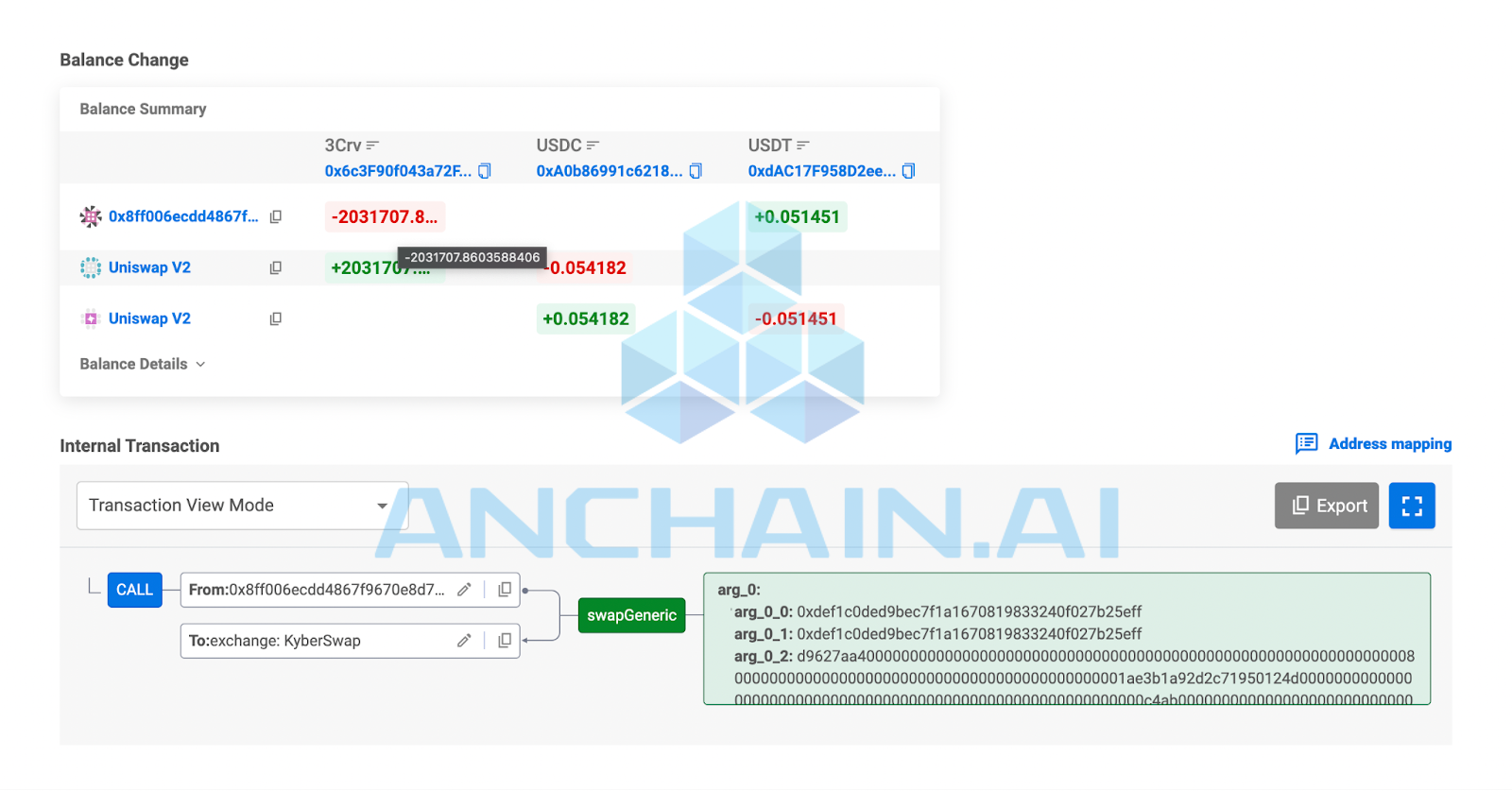
AnChain.AI SCREEN platform can simulate smart contracts token balance changes with internal contract calls. Example output for technical reference.[6]
Simulations and automated contract explanations must be validated against historical state and transaction receipts before submission as legal evidence.
The AnChain.AI team conducted a detailed review of the public records to uncover further insights into this recovery, specifically regarding the smart contract forensics involved.
USDT on Ethereum is governed by the smart contract at 0xdAC17F958D2ee523a2206206994597C13D831ec7, which includes specific administrative functions:
These contract calls alter ledger state on-chain without overwriting historical transaction logs. Blacklisting restricts transferability, burning removes balance, and reissuance creates replacement supply.
In the Maine case, court filings document Tether’s initial freeze of account 0x55Df4Ecd9066C417103F59d3eCc9B309Dedfd131 in October 2022, followed by token destruction, reissuance, and transfer of 470,773 USDT to federal custody in March 2024.
Counsel should obtain raw administrative transaction receipts, event logs, and state changes to verify issuer actions independently. SCREEN enables forensic teams to verify contract-level controls before initiating legal proceedings.[5]
AnChain.AI prepares a more detailed technical timeline including the blacklist related recovery events:
Forensic reports must categorize findings into three distinct evidentiary tiers:
Attribution labels must disclose their source, retrieval timestamp, and confidence rating. When tracing across chains or bridges, require protocol-specific event logs rather than relying solely on timing heuristics or matching amounts.
Tracing funds through multiple intermediate wallets increases gross transaction volume but does not increase principal loss. Accounting schedules must separate initial outflows, traced balances, network fees, and net recovery targets.
Specify exact pricing sources and valuation timestamps when converting token balances to fiat currency values.
Address asset commingling explicitly. If illicit funds mix with unblemished assets in an intermediary wallet, the forensic accountant must state the tracking convention applied (e.g., FIFO, LIFO, or proportional allocation) and demonstrate how alternative methods impact the claim.
Under Federal Rule of Evidence 702, expert testimony requires reliable principles, sufficient facts, and sound methodology. Raw software visual graphs alone do not satisfy evidentiary standards.[2]
Deliverables must include complete transaction schedules, annotated trace maps, methodology documentation, data source exports, and cryptographic hashes (e.g., SHA-256) of raw data files to verify chain of custody and data integrity.
Establish expert witness availability, disclosure requirements, and scope of testimony prior to final submission.
AnChain.AI Insights combines transaction visualization, wallet intelligence, and automated reporting. SCREEN provides in-depth smart contract execution analysis, permission verification, and state auditing. Together, these tools enable legal and forensic teams to convert complex blockchain activity into court-ready evidence.[4]
To evaluate investigative support for an active matter, begin with a bounded forensic assessment to validate source transactions, identify evidence gaps, and define strategic deliverables.
No. Tracing identifies flow of funds and potential leverage points, but recovery depends on asset availability, jurisdiction, issuer capabilities, and judicial remedies.
Provide initial transaction hashes, wallet addresses, target networks, exchange records, relevant communications, key deadlines, and a concise factual timeline.
Yes. AnChain.AI conducts peer reviews of third-party tracing reports to evaluate methodology, attribution reliability, accounting assumptions, and data integrity.
To discuss a pending crypto investigation or review existing blockchain evidence, schedule a case assessment with AnChain.AI.
Disclaimer:
This article is for informational and educational purposes and is not legal, financial, or investment advice. The Maine case discussion relies on the cited public records; allegations are attributed to the filings, and AnChain.AI does not claim involvement in that recovery. References to DOJ, the FBI, and Tether do not imply endorsement or affiliation. Blockchain tracing and smart-contract analysis do not guarantee asset recovery, issuer cooperation, or admissibility of evidence. Outcomes depend on the facts, available assets, applicable law, and decisions by courts and relevant institutions. Consult qualified counsel regarding a specific matter.
© 2026 AnChain.AI. All Rights Reserved | Privacy Policy