© 2026 AnChain.AI. All Rights Reserved | Privacy Policy


Disclaimer: This AnChain.AI article is for general informational purposes and does not constitute legal, investment, tax, or compliance advice.
On August 18, 2026, the U.S. Securities and Exchange Commission (SEC) proposed Regulation Crypto Assets, a framework designed specifically for certain investment contracts involving crypto assets. [SEC link]
The proposal could give cryptocurrency token issuers clearer paths to raise capital in the United States. More importantly, it introduces a lifecycle model: disclose what the issuer promises to build, report while that work continues, and provide evidence when the promised managerial work is complete.
This is a significant shift from years of regulatory uncertainty and case-by-case enforcement. It is not broad deregulation. Antifraud and antimanipulation rules would remain in force, and the proposal would not replace AML, sanctions, commodities, custody, tax, cybersecurity, or other legal obligations.
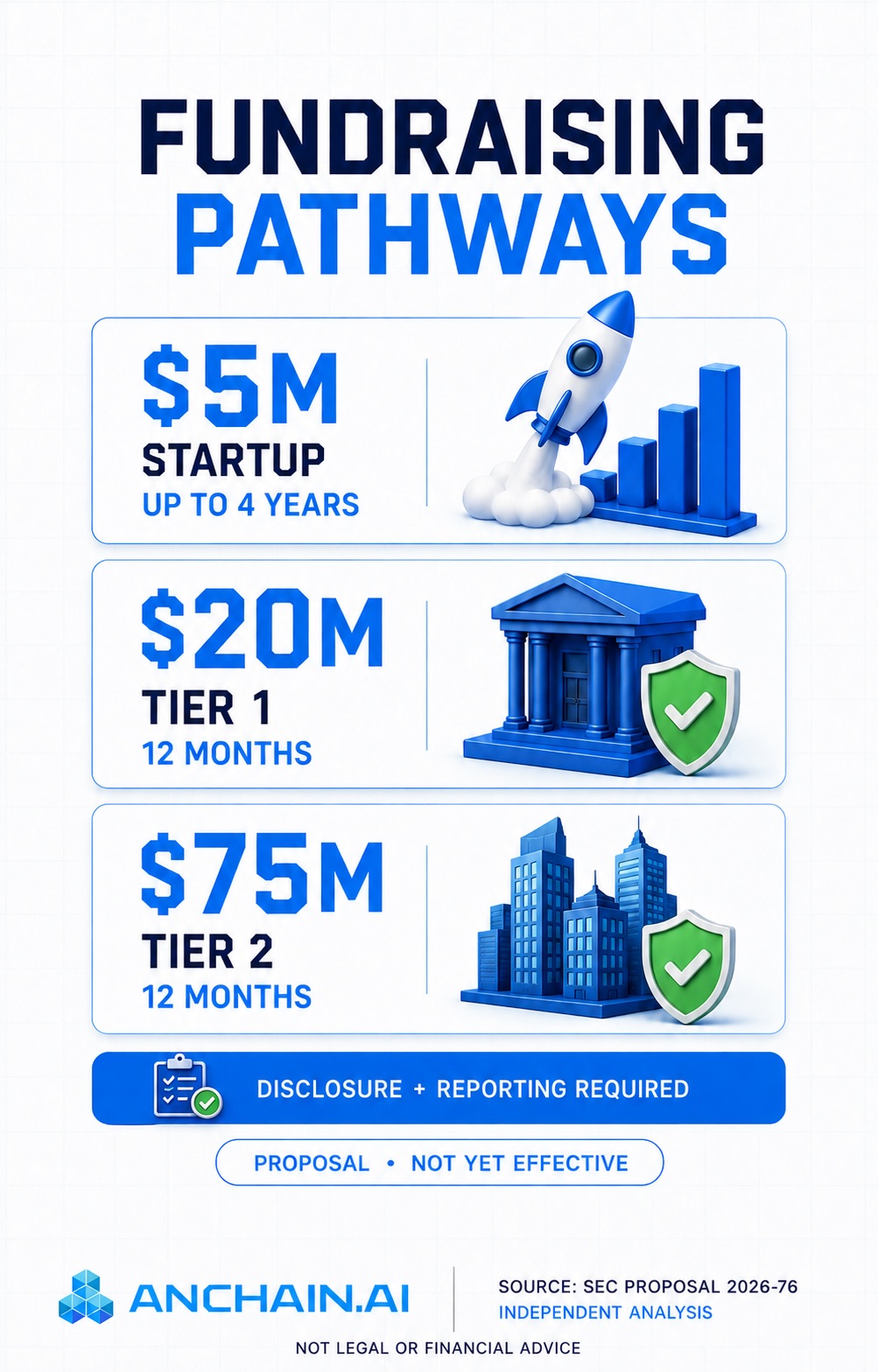
The startup exemption would allow an issuer to raise up to $5 million over a period of as many as four years. Issuers would make public filings when entering and leaving the exemption and provide principles-based disclosures while relying on it.
A separate fundraising exemption would have two tiers.
Tier 1 would permit offerings of up to $20 million in a 12-month period.
Tier 2 would permit up to $75 million. Both tiers would require public offering materials, financial information, and ongoing reporting. Tier 2 would require audited financial statements.
The proposed investment-contract safe harbor addresses a more fundamental question: when can a crypto asset separate from the investment contract through which it was originally sold?
An issuer would need to show that it completed or permanently stopped all essential managerial efforts previously promised to purchasers, that it is not making new promises of that kind, and that it filed a public certification supported by legal and factual analysis.
The proposal is not yet effective law. Its requirements may change through public comments and the final rulemaking process.
On September 9, 2025, AnChain.AI met with the SEC Crypto Task Force to discuss the interpretation of rules and forms in digital-asset compliance. [SEC memo link]
AnChain.AI’s submission focused on 5 practical issues:
The SEC meeting record documents the discussion. It does not constitute an agency endorsement of AnChain.AI or establish that the submission caused the later proposal. However, the comparison highlights where legal policy and technical implementation converge.
Regulation Crypto Assets directly addresses two major issues: compliant token fundraising and the lifecycle of an investment contract. It also advances principles-based disclosure and creates a stronger foundation for SEC-CFTC coordination.
Important implementation questions remain unresolved.
The proposal does not appear to provide a complete answer on whether filings must identify controlling wallets, deployed contracts, upgrade keys, vesting contracts, bridge deployments, or related-party addresses. It does not fully modernize every existing securities form. It also does not consolidate separate SEC, FinCEN, OFAC, CFTC, banking, and state obligations into one compliance process.
These gaps matter because a disclosure is only useful when it can be connected to the real asset, contract, transaction, and controlling entity.
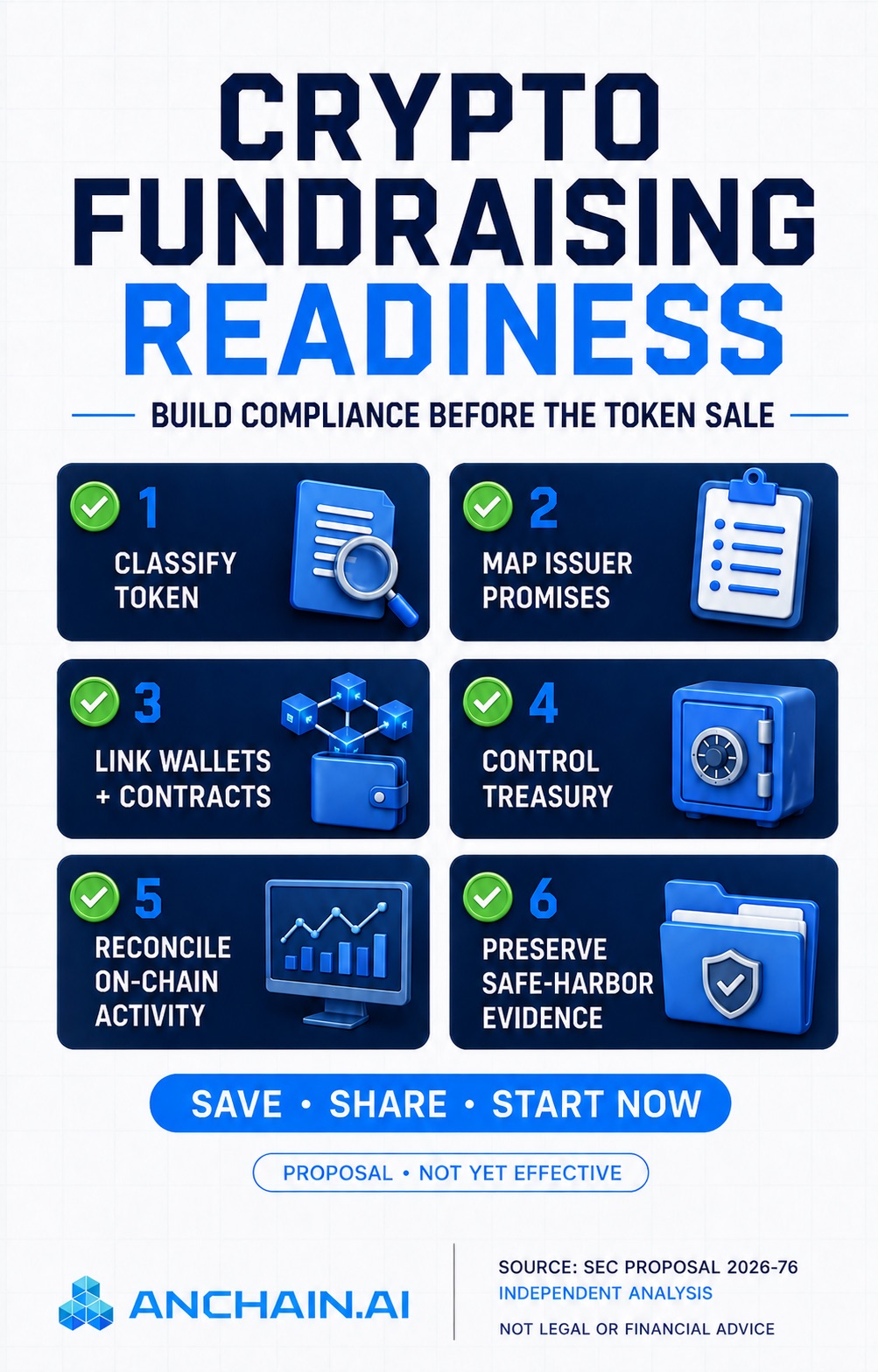
The emerging framework will require more than a legal conclusion. Effective compliance must connect four evidence layers: regulatory claims, corporate records, smart-contract controls, and blockchain transactions.
AnChain.AI’s blockchain intelligence can support that evidence layer through wallet screening, entity attribution, cross-chain tracing, smart-contract risk analysis, transaction monitoring, and reproducible investigation reports. These tools do not replace lawyers, auditors, or compliance officers. They help make professional conclusions testable.
The central opportunity in Regulation Crypto Assets is clarity. The corresponding obligation is accountability.
Token issuers that build continuous, evidence-based compliance systems will be better positioned to use the proposed exemptions, support future safe-harbor certifications, and earn the confidence of investors, intermediaries, and regulators.
Preparing for crypto fundraising, disclosure, or AML readiness?
• Schedule a free consultation with AnChain.AI’s experts.
• Request the free AnChain.AI SEC Regulation Crypto Assets Fundraising Playbook for crypto startups.
https://anchain.ai/demo
[1] U.S. Securities and Exchange Commission, “SEC proposes new Regulation Crypto Assets,” Press Release No. 2026-76, Aug. 18, 2026. [Online]. Available: https://www.sec.gov/newsroom/press-releases/2026-76-sec-proposes-new-regulation-crypto-assets.
[2] U.S. Securities and Exchange Commission, Crypto Task Force Staff, “Meeting with representatives of AnChain.AI, Inc.,” memorandum, Sept. 9, 2025. [Online]. Available: https://www.sec.gov/files/ctf-memo-anchain-ai-090925.pdf.
Disclaimer: This AnChain.Ai article is for general informational purposes only and does not constitute legal or financial advice. Consult qualified legal, financial, or compliance professionals regarding your specific circumstances.
© 2026 AnChain.AI. All Rights Reserved | Privacy Policy